
Chapter 7: 21-Day Action Plan
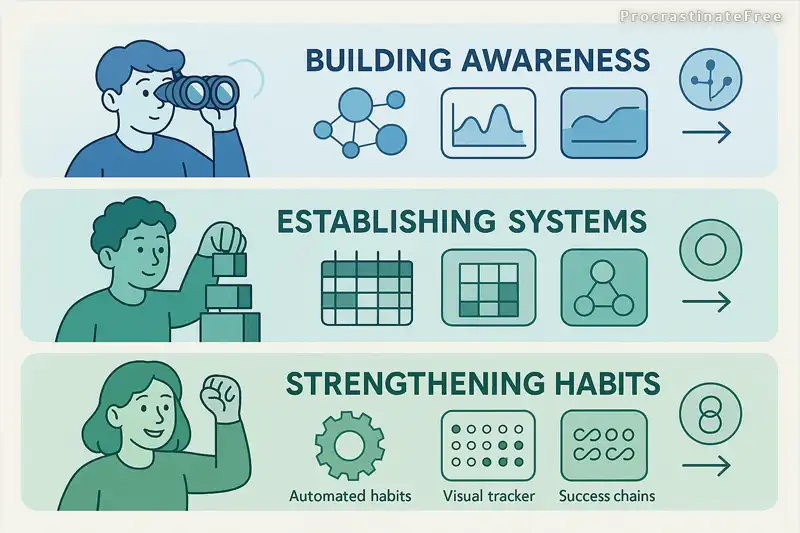
Week 1: Building Awareness
The first week of your transformation plan focuses on building awareness about your current procrastination patterns. Without judging or trying to change immediately, you will simply observe.
Day 1-3: Procrastination Mapping
- Daily activity: Record each instance of procrastination using the TRAP method:
- T - Trigger: What initiated the behavior?
- R - Response: What did you do instead of the original task?
- A - Atmosphere: Where were you? What were the conditions?
- P - Pattern: Do you notice any emerging pattern?
Example: A data analyst notices that they consistently procrastinate when they need to write reports (task), checking emails unnecessarily (response), especially when they're at their shared desk (atmosphere), and this happens predominantly in the late afternoon (pattern).
Day 4-5: Energy Analysis
- Daily activity: Every hour, assess your mental and physical energy level on a scale of 1-10
- Recommended tools: Energy Clock app or a simple spreadsheet
- Implementation: Use different colors to mark your energy peaks and valleys
Example: A project manager discovers she has creative energy peaks between 8-10 AM, but experiences a significant drop after lunch. She reorganizes her schedule to place strategic tasks in the morning and lighter administrative work during her energy valley.
Day 6-7: Values Audit
- Activity: Answer these fundamental questions:
- What are my three most important professional values?
- Which tasks do I procrastinate on that are aligned with these values?
- Which tasks do I complete promptly that are misaligned?
- Reflection: Write a purpose statement connecting your daily tasks with your deepest values
Example: A university professor identifies "educational impact," "intellectual rigor," and "mentorship" as their core values. They realize they procrastinate on lesson preparation (aligned with their values) while promptly responding to administrative emails (less aligned). This discovery led them to fundamentally rethink their priorities.
Week 2: Establishing Systems
The second week focuses on creating practical systems to replace procrastination behaviors with productive routines.
Day 8-10: Task Initiation System
- Daily activity: Apply the "5-4-3-2-1-Start" technique
- For each important task:
- Identify 5 benefits of completing it
- List 4 necessary steps
- Define 3 resources you'll need
- Establish 2 progress milestones
- Set 1 reward for completing it
- Start immediately for 5 minutes
- For each important task:
Example for different professions:
| Profession | Initiation System Application |
|---|---|
| Developer | Applied to refactoring legacy code task |
| Designer | Applied to starting a new creative concept |
| Salesperson | Applied to difficult prospecting calls |
| Accountant | Applied to complex account reconciliation |
Day 11-13: Strategic Time Blocking
- Activity: Implement the "3-2-1" time blocking system:
- 3 "deep work" blocks (90 minutes) for your most significant tasks
- 2 "processing" blocks (30 minutes) for email and communications
- 1 "planning" block (15 minutes) for reflection and adjustment
Practical implementation:
- Use color codes in your calendar
- Schedule reminders 5 minutes before each block
- Communicate your availability hours to colleagues
Example: An HR consultant implements the 3-2-1 system, blocking her mornings for training development (deep work), two 30-minute windows for responding to requests (processing), and 15 minutes at the end of the day to plan the next day (planning). In two weeks, her project completion rate increased by 35%.
Day 14: System Review Day
- Activity: Conduct a retrospective using the "SSS" structure:
- Stop: What isn't working and needs to be stopped?
- Start: What new elements need to be introduced?
- Sustain: What's working well and should continue?
Example: A marketing director identifies that their current notification system constantly distracts them (Stop), needs to implement a "do not disturb" policy during creative periods (Start), and their new morning planning ritual is working exceptionally well (Sustain).
Week 3: Strengthening Habits
The third week focuses on solidifying systems into sustainable and automated habits.
Day 15-17: Habit Stacking Technique
- Daily activity: Connect new productive habits to existing habits using the formula:
- "After I [current habit], I will [new habit]"
- Create at least three strategic stackings
Examples by profession:
| Profession | Habit Stacking |
|---|---|
| Manager | "After I check my morning email, I will dedicate 20 minutes to the most important task of the day" |
| Designer | "After I make my coffee, I will sketch ideas for 15 minutes before opening any social media" |
| Programmer | "After I do daily scrum, I will document my code for 10 minutes" |
| Lawyer | "After I return from lunch, I will work on complex documents for 40 minutes without interruptions" |
Day 18-19: Habit Tracker Creation
- Activity: Build a visual tracking system for your three most important anti-procrastination habits
- Suggested tools: Loop Habit Tracker (digital) or a simple printed calendar with markings
- Application: Keep your tracker visible and update it consciously and consistently
Example: A financial analyst created a tracker for three key habits: starting report analysis before 9 AM, conducting a portfolio review at midday, and preparing the next day's priority list before closing work. Visualizing their "streaks" of consecutive days significantly increased their consistency.
Day 20-21: Habit Maintenance Plan
- Activity: Develop your "Restart Protocol" using the "IF-THEN" structure:
- Identify potential disruption scenarios
- Create specific response plans for each one
- Document in an accessible location
Examples of IF-THEN protocols:
- "IF I miss a day of focused work THEN I will start the next day with 30 minutes of work on the same task before checking emails."
- "IF I notice I'm procrastinating for more than 10 minutes THEN I will change environments and apply the 5-minute rule."
- "IF an entire week passes without progress on important projects THEN I will schedule a complete system review followed by a protected 2-hour work session."
Maintaining Long-Term Progress
To sustain your new relationship with productivity beyond the initial 21 days, you'll need structures that support continuous growth.
1. Monthly Reflection Cycle
Establish a "Productivity Review Day" on the last Sunday of each month, using the "4Rs" structure:
- Review: Examine your records and trackers
- Reflect: Consider patterns and insights
- Recalibrate: Adjust systems that aren't working
- Reward: Celebrate wins and progress
2. Continuous Accountability System
- Implement a "Productivity Council" – a small group (2-3 people) you meet with quarterly
- Share your biggest challenges and wins
- Request specific feedback on your systems
- Offer insight and support to others
3. Continuous Evolution Practice
- Reserve 1% of your work time (approximately 25 minutes per week) for "system maintenance"
- Read one productivity book each quarter
- Experiment with a new technique or tool monthly
Integrated example: Elena, an architect, incorporated all three elements into her professional life. She established her monthly reflection cycle on the last Sunday, formed an accountability group with two colleagues from different fields, and dedicates 30 minutes each Friday to adjusting her systems. Six months later, she not only eliminated her chronic procrastination patterns but also developed a reputation for consistently delivering projects ahead of schedule, which led to new opportunities in her career.
The journey to overcome procrastination doesn't end after 21 days. What we're cultivating is a new identity as a person of action, supported by carefully designed systems and sustainable habits. The beauty of this approach is that it becomes increasingly easier over time, as your new practices transform into your second nature.